
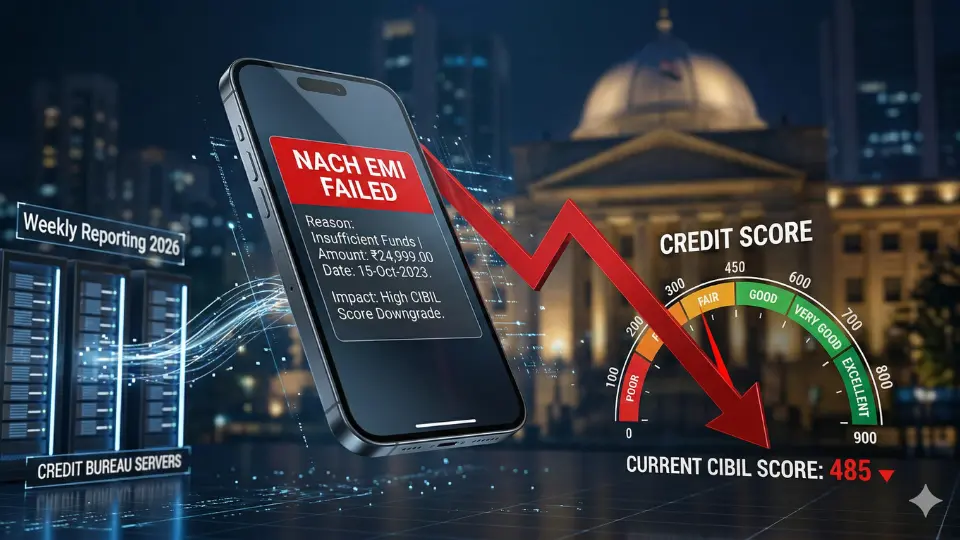
Imagine this scenario: You are having a perfectly peaceful morning, maybe enjoying a nice, warm cup of chai, when your smartphone suddenly buzzes with a new SMS. You casually glance at the screen, and instantly, your heart drops straight to your stomach. Your bank has just cheerfully informed you that your monthly EMI auto-debit has failed!
We have all been there, and it is a universally terrible feeling. Sometimes, it is just a genuinely silly miscalculation of your savings account balance after a weekend shopping trip. Other times, the frustrating culprit is your employer delaying your hard-earned salary by a single, agonizing day.
Whatever the specific reason, that dreaded “bounce” notification triggers an immediate wave of pure financial panic. In the good old days, you might have just cursed under your breath, paid the minor penalty fee, and quickly moved on with your life.
However, the financial landscape in India has drastically changed this year, making the EMI auto-debit failure consequences significantly more severe. It is absolutely no longer just about losing a few hundred rupees to annoying, hidden bank charges.
Today, an accidental low balance is an immediate, glaring threat to your entire credit profile and future borrowing power. If you are deeply stressed about the same day NACH bounce impact on CIBIL score, you have every right to be on high alert.
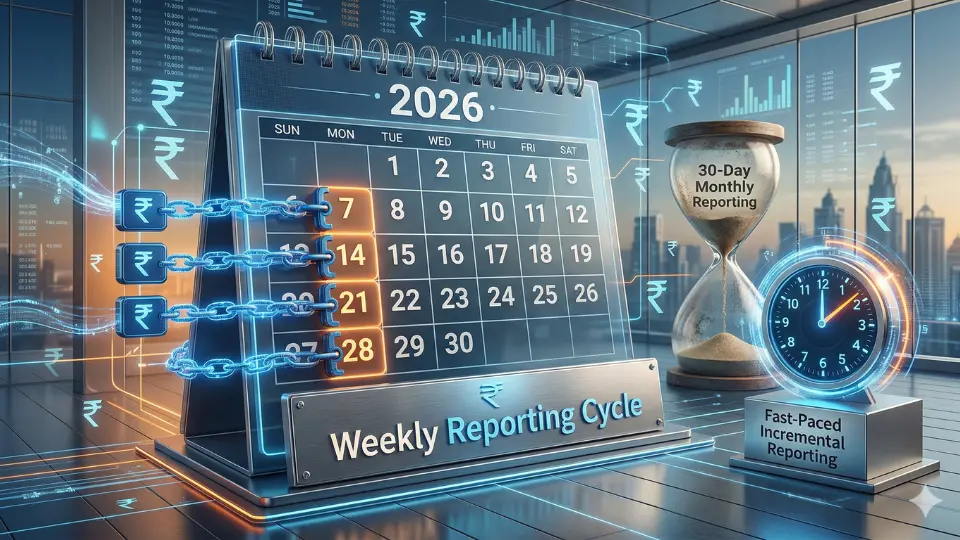
Under the strict, newly implemented directives from the Reserve Bank of India (RBI), the traditional 30-day grace period is officially dead and buried. Effective April 1, 2026, all regulated lenders are legally bound to follow a rather ruthless weekly credit reporting system.
Banks and NBFCs must now mandatorily update borrower default data with credit bureaus on the 7th, 14th, 21st, and 28th of every single month. This compressed timeline means a minor, accidental payment delay on a Monday could become a permanent black mark on your Credit Report by Thursday.
Because the banking system now updates in near real-time, understanding the exact same day NACH bounce impact on CIBIL score is mandatory for your financial survival. You literally do not have the luxury of waiting until your next paycheck to quietly fix a failed mandate.
So, how bad is the actual damage, and is there any realistic way to save your hard-earned credit rating? Take a deep breath, because this comprehensive, step-by-step guide will walk you through exactly what you need to do next.
First, we will dive deep into the mechanics of the new weekly reporting rules to understand the exact timeline of the threat. Then, we will reveal exactly how many points your credit score is projected to drop after a single mandate rejection.
Next, we will compare the brutal financial penalty tables across top Indian banks so you know exactly how much cash you are losing. Most importantly, we will reveal a highly effective 24-hour recovery strategy designed to minimize the same day NACH bounce impact on CIBIL score before the banks officially report your default.
Grab a notepad, quickly double-check your current active account balances, and let us learn how to actively protect your financial reputation from these modern banking traps!
Demystifying a NACH Mandate Rejection: What Actually Happens?
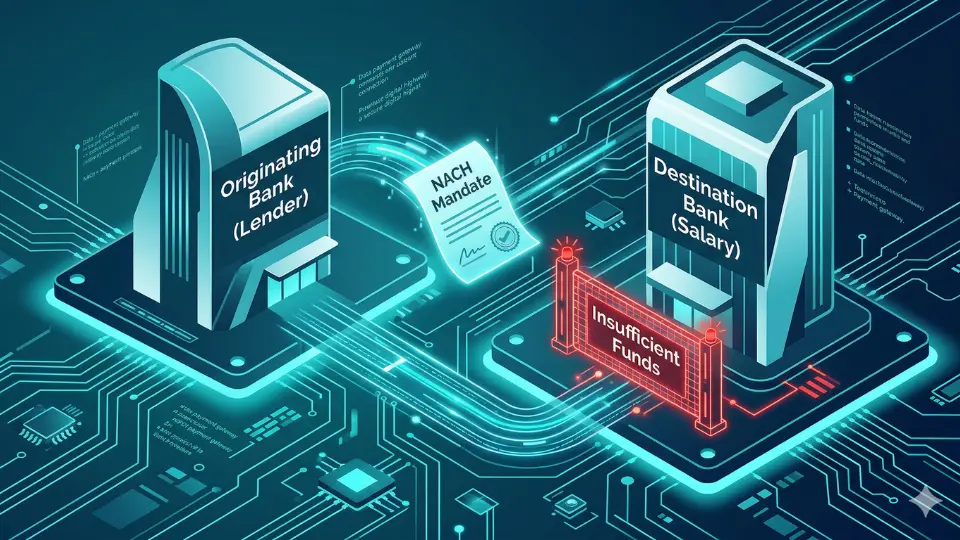
Let us keep it incredibly simple. A NACH mandate is basically a digital permission slip you give to your lender. It tells them they can legally take the EMI out of your bank account every single month.
When the EMI date arrives, the lender’s computer automatically talks to your bank’s computer. If your bank looks into your savings account and sees that the required money is missing, the permission slip fails.
This digital failure is what we call a NACH mandate rejection. It is basically your bank telling the lender, “Sorry, their pockets are completely empty today, please try again later!”
The Crucial Role of the Bank Presentation Date
Behind the scenes, this entire digital highway is managed by the [suspicious link removed]. Think of them as the strict traffic cops of the Indian banking world.
When your lender officially asks your bank for the monthly EMI, this specific moment is called the bank presentation date. This is the exact second your financial fate for the month is decided.
Here is the funny, yet incredibly frustrating part. You might not receive the dreaded “bounce SMS” until hours later while you are peacefully eating your evening samosas.
However, the banking system does not care about your SMS delivery timing. The default was officially flagged the exact millisecond the presentation failed at the NPCI clearing house.
How the RBI Weekly Credit Reporting 2026 Changes Everything
This is the part that every borrower needs to memorize immediately. If you have been relying on the old banking rules to manage your money, you are walking into a massive trap.
In the past, banks only sent your credit data to the bureaus once a month. This gave you a very comfortable 15 to 30-day grace period to manually pay your EMI and hide your mistake.
Those days of easily hiding your late payments are officially gone. The Reserve Bank of India (RBI) has flipped the entire banking sector upside down with a massive new directive.
Effective April 1, 2026, the RBI mandated a strict weekly credit reporting system for all lenders. The traditional, forgiving monthly cycle has been permanently thrown out the window.
Banks and NBFCs are now legally required to submit borrower data on the 7th, 14th, 21st, and 28th of every single month. Because of this, the old grace period is completely dead.
This incredibly fast reporting cycle is exactly why understanding the same day NACH bounce impact on CIBIL score is non-negotiable. Your financial mistakes are published almost instantly.
Let us say your EMI auto-debit date is the 5th, and it accidentally bounces. Under the new 2026 rules, your lender will report that specific default to the bureaus on the 7th.
Within just 48 hours, that negative mark is permanently plastered across your Credit Report. You literally have no time to wait for your next paycheck to clear the outstanding dues.
This reality means the same day NACH bounce impact on CIBIL score is no longer a future problem to worry about later; it is a present-day emergency that requires immediate action.
Many users still naively believe they can just pay the penalty fee the next week and everything will be fine. They severely underestimate the permanent same day NACH bounce impact on CIBIL score under this new weekly framework.
Imagine you are planning to apply for a shiny new car loan next week. You accidentally miss your current personal loan EMI on the 12th by just fifty rupees due to a calculation error.
Because of the new rules, the lender reports this default on the 14th. When you walk into the car dealership on the 16th, your loan gets instantly rejected.
By the time you finally open your banking app to fix the failed mandate, the damage is already done. In this hyper-connected banking era, speed and vigilance are your only true defenses.
The Real Damage: How Many Points CIBIL Drops After NACH Bounce

Let us face the giant elephant in the room. The absolute biggest fear every borrower has is watching their precious, three-digit financial report card crash and burn.
When you get that dreadful mandate rejection SMS, your first panicked thought is usually about the exact math. You are desperately wondering, “How much actual damage did I just do to my profile?”
While credit bureaus like TransUnion CIBIL keep their exact calculation algorithms a closely guarded secret, the reality is quite harsh. The same day NACH bounce impact on CIBIL score is certainly not a minor slap on the wrist.
Based on historical data and the strict new RBI weekly reporting cycles, you can expect a brutal drop of anywhere between 20 to 50 points. Yes, a single silly calculation mistake can instantly wipe out months of your good financial behavior!
Here is the highly ironic part that most borrowers do not realize. The higher and healthier your current credit score is, the harder you will actually fall.
If you boast a proud, premium score of 800, a single auto-debit failure could easily drag you down by a massive 50 points. The banking system views a highly responsible borrower making a sudden mistake as a major, terrifying red flag.
However, if your Credit Report is already sitting at an average or risky 650, the drop might be a smaller 20 points. But honestly, when your score is already that low, every single point is a matter of life and death for future loan approvals.
This brutal, unforgiving math is exactly why understanding the same day NACH bounce impact on CIBIL score is absolutely critical today. You are not just losing a few random points; you are instantly losing your premium borrower status and negotiating power.
Does Paying Next Day Reverse CIBIL Drop?
Now, let us tackle the most common, hopeful question that floods my inbox every single day. If you panic, borrow money from a friend, and pay the EMI the very next morning, does the CIBIL drop magically vanish?
I really hate to be the bearer of bad news, but the short, blunt answer is: Absolutely not. Think of your credit history like a strict school permanent record; a quick apology does not erase the permanent ink.
Just like the massive difference between a loan settlement vs loan closure, there is a fundamental difference between simply paying your outstanding due amount and erasing the actual ‘bounce’ footprint. These are two completely different events in the eyes of the modern banking system.
When you manually pay the next day, your loan account balance happily returns to zero. The lender finally gets their money, and you successfully stop accumulating those nasty daily late payment penalty fees (which act very similarly to the severe penalties triggered by a missed first credit card payment).
However, the actual event of the NACH mandate failing on the exact presentation date is permanently recorded. The same day NACH bounce impact on CIBIL score remains safely and securely logged in the bureau’s massive servers.
Even if you clear the late payment within 24 hours, the historical record of that specific bounce will stain your report for up to 36 months. Future lenders will clearly see that you missed the original automated deadline, even if you paid shortly after.
This is exactly why the new 2026 weekly reporting mandate by the Reserve Bank of India is so terrifying for everyday borrowers. Before you can even open your banking app to fix the error, the default is officially published to the world.
So, please stop believing the dangerous, widespread myth that a quick manual transfer will magically erase your financial sins. Your best and absolutely only defense is to ensure your bank account is sufficiently funded well before the presentation date!
Comparing NACH Return Charges Across Banks
Let us be completely honest for a second. While watching your hard-earned credit rating nosedive is terrifying, there is a completely different kind of pain that hits much faster: the immediate deduction of your actual cash.
When an auto-debit fails, you are not just dealing with the dreaded same day NACH bounce impact on CIBIL score. You are also facing an instant financial penalty deducted directly from your savings account. It is a bit like slipping on a banana peel in public—not only is your reputation instantly bruised, but your wallet also falls out and spills everywhere!
Banks simply do not show mercy when your balance is low. The exact moment the [suspicious link removed] registers the mandate failure, your bank’s automated system triggers a penalty charge. Let us look at exactly how much this simple calculation mistake is going to cost you in today’s ruthless banking landscape.
HDFC and SBI NACH Bounce Charges 2026
Every major bank in India has a strict, updated schedule of charges for mandate rejections. Please note that the figures below are just the base charges. The government will happily add an 18% Goods and Services Tax (GST) on top of these amounts, making the pinch even sharper.
Here is the most accurate, updated data pulled from recent official banking circulars:
| Bank Name | Base NACH Bounce Charge (Excl. GST) | Notes on Consecutive Fails |
| HDFC Bank | ₹500 | Repeated failures may lead to higher penal charges as per updated 2026 slabs. |
| State Bank of India (SBI) | ₹250 – ₹300 | Varies slightly depending on your specific savings account variant. |
| ICICI Bank | ₹500 | Applicable per instance. Two bounces in a single month equals ₹1,000 lost. |
| Axis Bank | ₹500 | Subject to 18% GST. Automatically debited from the next available balance. |
Understanding ECS Bounce Penalty and Late Payment Fee Calculation
If you thought the bank charges in the table above were the end of the story, you might want to sit down. Welcome to the terrifying “Double Jeopardy” of the Indian financial world.
When an EMI bounces, you are actually getting punished by two completely different financial institutions at the exact same time. First, the bank where you hold your savings account slaps you with the standard ECS bounce penalty (like the ₹500 HDFC charge mentioned above) simply because the transaction failed on their internal platform.
But wait, there is more! The lender who originally gave you the loan—which could be a completely different NBFC or digital lending app—is also angry. They will instantly trigger a late payment fee calculation on your outstanding loan account. This is usually calculated as a flat penalty fee plus a penal interest rate of 2% to 3% per month on the overdue EMI amount.
It is exactly like getting a ticket from the traffic police, and then your car manufacturer sending you a separate fine just for driving too fast! While this financial double-whammy quickly drains your bank balance, always remember that the same day NACH bounce impact on CIBIL score is simultaneously destroying your future borrowing power in the background.
The Ultimate Nightmare: The Account Freeze Warning
Now, let us talk about the absolute worst-case scenario. What happens if you ignore these warnings, forget to check your Credit Report, and let your mandates bounce two or three times in a row?

Under strict new compliance protocols, repeated auto-debit failures signal severe financial distress or suspected fraudulent behavior to your home bank. If you hit this invisible threshold, you will likely trigger a devastating account freeze warning.
This is not a polite customer service email; it is a total operational lockdown. The bank has the authority to temporarily freeze all debit transactions on your account. Suddenly, your favorite UPI apps stop working (which is a massive headache if you are already navigating the recent UPI credit line scam), your debit card is embarrassingly declined at the local grocery store, and you are locked out of your own money until you visit the branch in person to explain the repeated failures.
Avoiding this humiliating scenario and stopping the massive same day NACH bounce impact on CIBIL score requires highly proactive account management. You must treat your EMI presentation dates with the exact same fear and respect as your income tax deadlines! Keep a solid buffer balance, and never let the automated system catch you off guard.
The 24-Hour Strategy: How to Fix Same Day NACH Bounce Immediately
Alright, the absolute worst has happened. You just received the dreaded SMS, your heart rate has spiked, and you are officially panicking about the same day NACH bounce impact on CIBIL score. Take a very deep breath.
Throwing your smartphone against the wall will not fix your credit profile, but taking fast, calculated action within the next 24 hours absolutely will. You are now in a high-speed race against the RBI’s strict new weekly reporting clock.
If you want to survive this sudden financial hiccup without permanent, long-term damage, you need to follow my battle-tested recovery strategy. Grab a strong cup of coffee, open your laptop, and let us get to work right now.

Step 1: Stop manual transfers to avoid double debits. Your very first panicked instinct will be to immediately log into your UPI app and manually transfer the missing EMI amount into your savings account. Do not do this blindly!
If the lender’s automated system is already programmed to re-present the failed NACH mandate the very next morning, your manual transfer will trigger a massive double deduction. You will suddenly be out of pocket for twice your normal EMI amount, creating a brand new cash-flow nightmare.
Step 2: Request a direct payment link from the lender’s official portal. Instead of guessing what the automated banking system will do next, pick up the phone and directly contact your lender’s customer support team. Clearly explain the accidental bounce and immediately ask for a custom, direct payment link.
Whether it is generated through their official WhatsApp bot or their secure web portal, paying through a direct link safely settles the specific overdue invoice. This officially closes your default window before the 7th, 14th, 21st, or 28th reporting cycle catches it.
Step 3: Secure the UTR transaction number immediately. The exact second your direct payment is successful, take a clear screenshot of the confirmation page and safely save the Unique Transaction Reference (UTR) number. This 22-digit number is your ultimate golden ticket.
If the lender’s automated system accidentally reports your default to the credit bureaus next week, this UTR number is your indisputable legal proof. You can easily use this UTR number to dispute errors on your CIBIL report directly through the official TransUnion CIBIL website to protect your profile..
Managing Your Credit Score Recovery Time
Let us be completely realistic about the aftermath of this stressful event. Even if you pay the missing amount within a few hours, the initial same day NACH bounce impact on CIBIL score might still temporarily drag your numbers down due to the unforgiving new rules.
If you check your Credit Report next month and see a sudden 20 to 50 point drop, please do not lose hope. Credit scoring models are highly elastic, and a single, isolated mistake is certainly not a permanent financial death sentence.
Based on historical data and banking algorithms, your expected credit score recovery time is generally between 3 to 6 months. If you want to quickly increase your CIBIL score from 600 to 750, you must practice flawless financial behavior during this critical recovery window.
Keep your overall credit card utilization strictly under 30%, ensure your primary savings account always has a healthy buffer, and set early calendar alarms for all future EMIs. Over time, the algorithm will naturally dilute the same day NACH bounce impact on CIBIL score, rewarding your newly disciplined banking habits!
The Ultimate Mandate Checklist to Protect Your Credit Report
Let us be completely honest: we are all a little forgetful. We forget anniversaries, we forget to reply to WhatsApp messages, and we definitely forget our exact EMI dates!
But while your spouse might eventually forgive a forgotten anniversary, the modern Indian banking system has zero sense of humor. A simple forgotten date now triggers the brutal same day NACH bounce impact on CIBIL score.
To survive the Reserve Bank of India’s strict new reporting rules, you cannot rely on pure memory. You need a foolproof system to protect your financial reputation from accidental disasters.
Please screenshot this exact checklist, save it to your phone, and review it monthly to completely avoid the devastating same day NACH bounce impact on CIBIL score.
Your Monthly Defense Checklist:
- Set a phone alarm 48 hours before the known auto-debit date. Do not wait for the actual EMI day to check your balance. A 48-hour head start gives you time to manually transfer funds if your salary is slightly delayed.
- Maintain a minimum buffer of ₹1,000 above your EMI amount. Banks love sneaking in random ₹295 debit card or SMS fees overnight. A ₹1,000 buffer ensures a tiny, hidden fee does not cause a massive mandate failure.
- Track all active mandates in your banking app’s “Standing Instructions” tab. Review this tab every single month. Cancel old, forgotten digital subscriptions before they accidentally trigger the same day NACH bounce impact on CIBIL score.
- Never change salary accounts without migrating NACH mandates 30 days prior. Switching your corporate salary account? Do not forget your old active mandates! Always submit new mandate forms to your lenders 30 days in advance to protect your Credit Report.
Frequently Asked Questions (FAQs)
Q1: What is the primary difference between an ECS and a NACH mandate?
Let us clear up this very common banking confusion. ECS (Electronic Clearing Service) is actually the older, much slower grandfather of the current digital auto-debit system.
NACH (National Automated Clearing House) is the modern, lightning-fast replacement managed entirely by the NPCI. Because NACH processes bulk transactions almost instantly, a failure triggers the same day NACH bounce impact on CIBIL score much faster than the old ECS system ever did.
Q2: Can I dispute a bounce charge if the bank’s server was down?
Absolutely! If your savings account had plenty of funds but the auto-debit failed purely due to a banking server crash, you are legally not at fault.
You must immediately email your bank’s grievance officer with a clear screenshot of your account balance on the presentation date. If the bank refuses to reverse the penalty charges, you can officially escalate the complaint to the RBI Ombudsman for a quick resolution.
Q3: Will a single mandate rejection stop me from getting a home loan?
Please do not panic; a single, isolated calculation mistake will not permanently destroy your dream of buying a house. HWhen determining the required CIBIL score for home loans, providers look at your overall 36-month repayment history, not just one bad week..
While the immediate same day NACH bounce impact on CIBIL score will temporarily lower your three-digit number, it is highly recoverable. If you have been a responsible borrower otherwise, and you quickly fix this error, most banks will overlook it after a few months of perfectly clean payments.
Q4: How do I check if my bank has already reported the bounce to CIBIL?
Thanks to the strict new 2026 weekly reporting rules, you absolutely cannot afford to just wait and guess. The banking system is now updating records on the 7th, 14th, 21st, and 28th of the month.
The fastest way to check the actual same day NACH bounce impact on CIBIL score is to directly download your latest credit profile. Log into the official TransUnion CIBIL portal and look specifically under the “Payment History” section for any red flags or missed payment markers.
Final Thoughts from the Editor
The Reserve Bank of India’s strict April 2026 weekly reporting mandate has permanently erased the traditional 30-day banking grace period.
Today, the same day NACH bounce impact on CIBIL score is a harsh, immediate reality. Getting that sudden bounce SMS feels a bit like dropping your smartphone in a puddle—it induces pure panic! But remember, a single calculation mistake does not make you a financial criminal.
By acting fast and using our 24-hour recovery strategy, you can quickly mitigate the worst of the damage. Speed and proactive communication with your lender are your absolute best weapons to protect your profile.
However, ignoring the problem will only multiply the permanent same day NACH bounce impact on CIBIL score, leading to surprise loan rejections when you need funds the most.
Do not let hidden errors ruin your future plans. Take five minutes right now to download your latest Credit Report. Ensure your financial slate is completely clean, dispute any unfair bank charges, and set those calendar alarms today!

Article created by: Anwar Hashmi
Chief Editor, Cibilized.in Anwar Hashmi is a dedicated financial blogger and content strategist based in Seohara, Uttar Pradesh. With a deep passion for simplifying complex Indian banking regulations, he actively helps everyday borrowers navigate RBI changes, protect their credit scores, and make empowered financial decisions. Contact: anwar@cibilized.in


Pingback: Unlock 750+: A Step by Step Plan on How to Improve Your CIBIL Score - CIBILized